
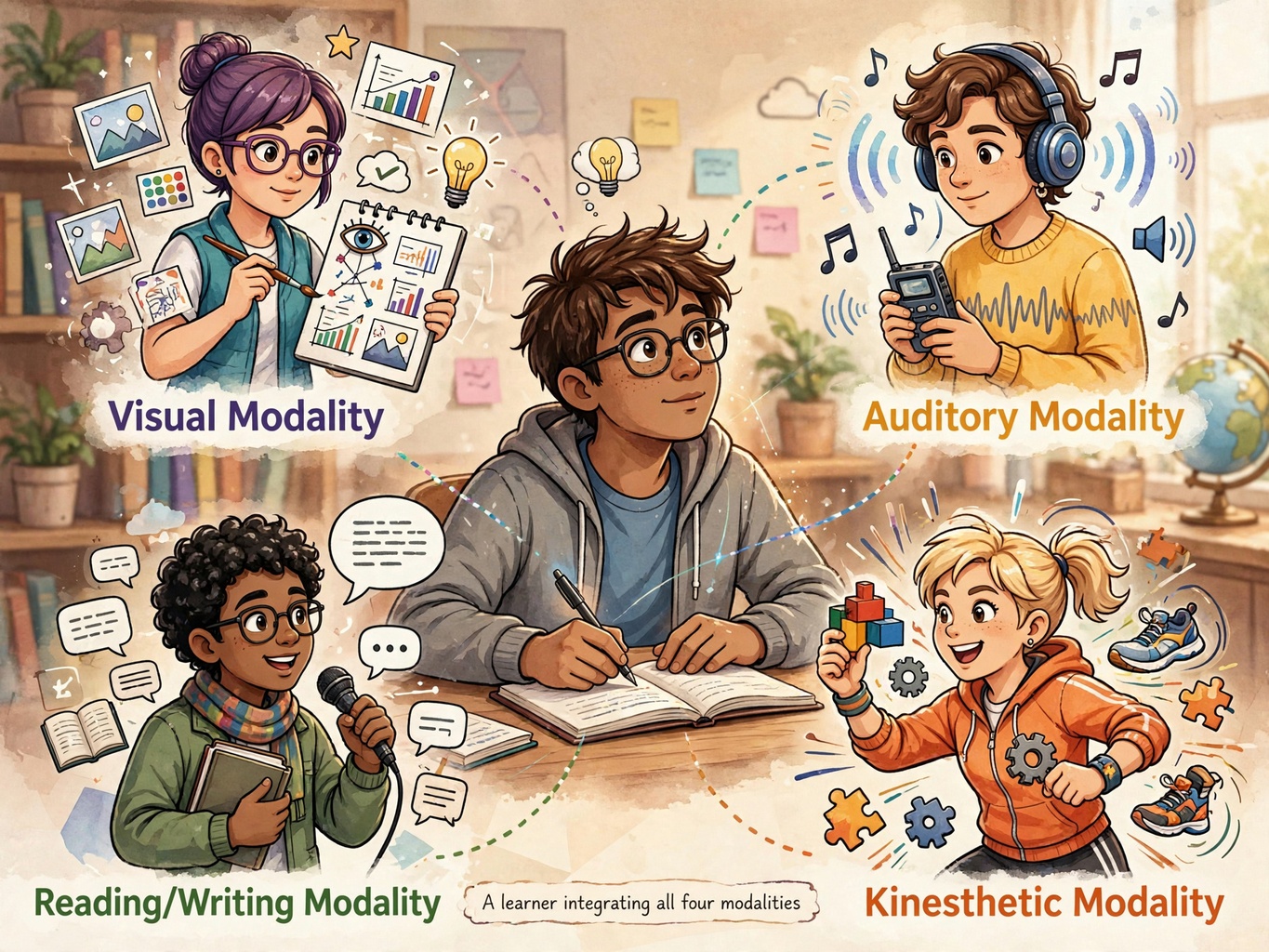
I’ve been wanting to write for a while now about sensory modalities and learning. An awful lot of rubbish gets talked about how people take in information by people who really should know better. A lot of it assumes that people, or at least most people, learn in the same ways. They don’t; not even close.
Each of us has a hierarchy to how well we take in information via different routes or “modalities”. Classically the VARK model is used to describe these modalities; Visual, Auditory, Reading/Writing and Kinesthetic. (I usually refer to the Reading/Writing modality as Verbal since it’s all about words, but VAVK makes an even worse acronym than VARK.) Simplistically, visually-oriented learners take in information well through signs and symbols, auditory learners like lectures, verbal learners would rather read a book about it and kinesthetics learn by doing. Given that vision is the strongest sense for most people, you might expect that most learning would be done visually, but you’d be wrong. Since classical times the lecture (later supplemented by the practical) has been the dominant method of teaching, and a lot of grumbling ensues. Learning to play a musical instrument, which you might think was purely kinesthetic, actually starts with reading sheet music or learning “by ear” before your fingers get involved. It’s all weirdly entangled.
The way I describe it above makes it sound as if modalities are a one-shot categorisation; you’re either visual or auditory or whatever. That’s not actually true, but it’s an easy fallacy to fall into. We all have a spread of affinities for the different modalities, but one usually dominates. This is frequently vision, which leads all too many people into the further fallacy of assuming that visual learning is clearly the best for everyone if only you can find a way of getting all the necessary information presented. That is much less true than you might think; slideshows and powerpoints are rarely any good as references. While vision is for most people the sense that we primarily rely on, the distribution of sensory modalities is much broader, and in practice what seems to work best is a multi-modal approach.
As I’ve mentioned before, I’m strongly kinesthetic with a large side-order of verbal and auditory modalities and visual trailing behind. This was actually quite a surprise when I found out; I’m a trained singer and an avid reader, and have a good auditory memory and verbal imagination, so I assumed one of those would dominate. However I came to this whole subject through psychotherapy, and it quickly became clear that touch and posture have a strong link with emotions and memory for me. I can literally lift my mood by sitting up straighter. Visual arts, on the other hand, don’t often evoke in me the emotions they clearly do in other people, and I have a poor memory for faces. Similarly a colleague has aphantasia (a lack of visual imagination), so one might assume visual learning didn’t work for him. In fact he strongly prefers to work through diagrams and charts, and it seems to be very effective for him.
My point here is that not only does everyone learn differently, but that difference is quite pervasive in our thinking and may not match up with your expectations. “I see!” you may exclaim when something becomes clear, or think that a realisation needs writing down. Personally I get a handle on things… you get the idea. The metaphors do in fact matter, and our preferred modalities will dominate in the ones that we naturally come up with. Note that I only said dominate there; I still see your point or hear what you’re getting at, it’s just that mostly I get a gut feeling about things.
You may be wondering what possible relevance this has to product design or business in general, especially if you haven’t read my rants about documentation (which are in retrospect awfully verbally-oriented). It comes down to this; if your product forces me to use a modality that I’m not comfortable with, eventually I’ll get uncomfortable enough to use something else even if it is “inferior” in some way. Because a majority of people are visually-oriented and I’m really not, I get hit by this all the time, but I’m not that extreme a case. This isn’t special pleading, because I’m not that special, it’s just common sense. If you don’t think about your product or advertising or whatever in terms of multiple modalities, then your message is predictably not going to land with more people than you would think. That’s a waste.
I don’t normally add references to these articles, but Neil Fleming’s 1995 paper on the subject and how his university used it are informative reading.
Fleming, N.D; (1995), I’m different; not dumb. Modes of presentation (VARK) in the tertiary classroom, in Zelmer,A., (ed.) Research and Development in Higher Education, Proceedings of the 1995 Annual Conference of the Higher Education and Research Development Society of Australasia (HERDSA),HERDSA, Volume 18, pp. 308 – 313. Link: https://www.vark-learn.com/wp-content/uploads/2014/08/different_not_dumb.pdf
Also despite the term being coined a decade ago, many people haven’t come across aphantasia before. I hadn’t heard of it until last year. The Aphantasia Network (https://aphantasia.com/) has quite a bit of information, including videos by people with aphantasia explaining how they don’t have a “mind’s eye” and what that means.