
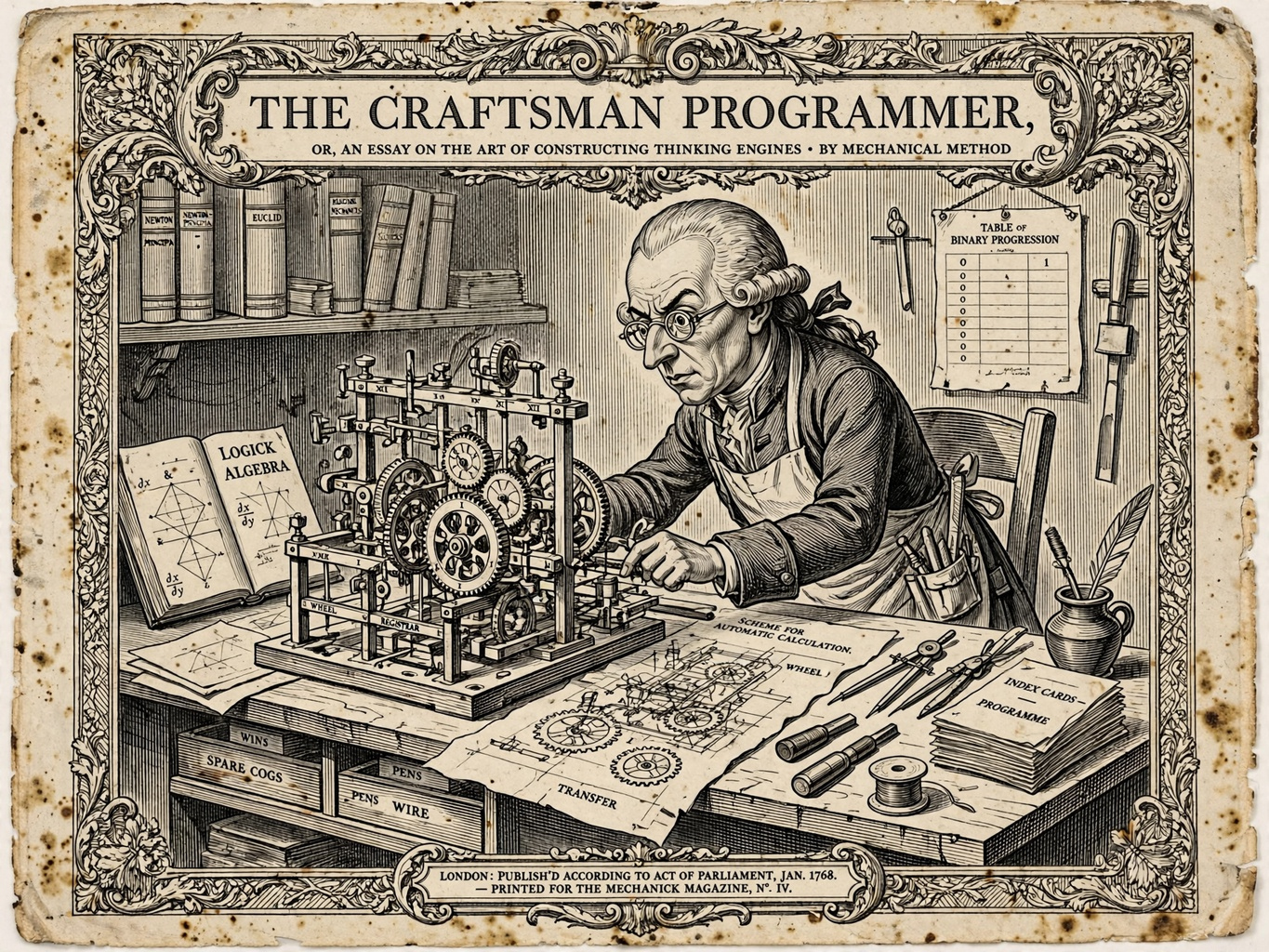
I seem to be developing a thesis about the social effects of AI in the software industry that I don’t think anyone has properly articulated yet, though some people have come close. I’ve seen plenty of articles analysing how good AIs are at coding now, and what effects that will have on programming practices. See for example The Pragmatic Engineer article “When AI writes almost all code, what happens to software engineering?” I think they share one common flaw; they are all written from the point of view of software engineers wanting to do software engineering, and they are missing something more fundamental.
When Carl Benz first created the Benz Patent-Motorwagen in 1886, much mechanical engineering was still a craftsman’s job. Benz’ cars were assembled by hand, and while many of the parts may have been mass produced, many were likely created by hand. The design required imagination, forethought and problem-solving skills, dealing with issues no one had come up against before. As time passed they developed into what we would recognise as cars, and they were products of craftsmanship. Skilled men (mostly) had poured their love of building things into them piece by piece, and they worked as well as our slowly growing knowledge of the technology would allow them. You could call them beautiful and unique, but they took time to come out of the workshop.
Then Henry Ford applied the idea of the production line, bringing automation to building cars. Each worker specialized in their section of the line, craftsmen giving way to much less skilled labourers doing much smaller tasks. Cars came off the production line faster than they did out of the craftsman’s workshop. They lost some of that love and most of the uniqueness, but they were available to be bought. As time has passed, more and more of the manufacturing work has automated, and those labourers have stepped further and further away from the underlying process. This is how automation works: craftsmanship is replaced by gradually less skilled labour, and gradually less of it per unit produced.
AI is automation of the software industry.
I’m focusing specifically on the programming uses of AI here; there are far more uses of AI than writing code, just as there are far more uses for robots than building cars. The point is that programming used to be a craft, and when you try to mess with craftsmanship quality suffers. AI is the automation tool that allows for replacing the craftsman with skilled labourers, people who know enough to drive their AIs and understand their outputs, but not ever have to carve something from the living code themselves. There will be — are — complaints about the quality of the results, but AI programming is already good enough, and it will get better. The cars that rolled off Ford’s production line didn’t have the same quality and individuality as the ones that were hand-crafted, but they didn’t have to. They only had to be good enough for the advantage in speed to be the telling factor.
Now you may argue that I’m not comparing like with like here. Car assembly lines produce runs of identical vehicles, whereas every software product is different. True, I would say, but only to an extent. Software engineering long ago reached the point where under the surface many products aren’t that different really. That’s the whole point of libraries and frameworks, after all. It’s oversimplifying to say that modern programming mostly consists of chains of modules taking data from one or more inputs, sometimes applying a transformation, and sending it to one or more outputs, but it’s not as much of an oversimplification as most of us would like to think. When you view it like that, it looks a lot like bolting together pre-existing parts, just like a production line does. We choose which parts to bolt together and how robust those bolts have to be, but we do it in light of an overall design. AIs are becoming just as capable of making those choices as we are, given the same design. I like to imagine that the work of consultants at the sharp end of innovation doesn’t automate well purely because it’s all about creativity, but in other areas we have collectively been working towards automation for a long time.
So I’m expecting a lot of software engineering jobs to become more software assembly line jobs. That’s not to say that there isn’t a place for craftsmen in the software industry, just that it’s not going to be at the code face anymore. The day-to-day need for code writing will diminish, because your AI production line will be doing that for you, but there will still be a need for craftsmanship in design, especially in situations where you are breaking new ground. Just not as much of a need as there currently is for creativity and imagination in coding itself.
I am privileged to have lived through the time of the craftsman programmer. I left school just as home computing was becoming affordable in the UK, so I missed out on the great age of the mainframe, but I have lived through the rise of the Internet, web programming, smart phones, cloud computing and all the rest of it. I got to have a job that brings me the joy of building something with my virtual hands. When I started work, the idea of a mass market software industry was novel, and it changed even as I joined it. It has changed multiple times over the years. By the time I retire, not that far in the future, the software industry will have changed yet again. I’m an old curmudgeon now, but even I can see the inevitable. I likely won’t enjoy overseeing a software assembly line as much as doing the assembly myself, but as a consultant I will still have plenty of need for the craft skills I have developed over the years.
I asked in my last article how companies were going to train new junior engineers when they were giving all the scutwork to AIs. Pace the thinking that Alan Braggins and others have put into the subject, I now think my question was missing the point. The skills needed by new programmers aren’t the ones I and my colleagues learned over the years, because their jobs aren’t going to be the same as ours were. They will be the software assembly line’s skilled workers, and only a few will need the engineering skills we cultivated.
If you think this is sad, it is, but it’s also the way progress has always worked. Take comfort in the fact that craftsmen still exist, not just the few professionals the market can afford but also the amateurs literally doing it for love of their craft.
My question to ruminate over this week is a more general social one. As I said above, historically industries have introduced automation over time with the objective of producing more stuff with fewer people, and the lauded thought has always been that we are moving towards a society that has more leisure time. John Maynard Keynes famously predicted that we would all be working 15 hour weeks by now. In all the time we have been doing and saying this, why have we made such little progress towards that society? Don’t we still value people by what they do for work? In the same breath, don’t we still invidiously dismiss the work housewives do (and ignore househusbands altogether)? Something to think about, and it looks like there’s no shortage of scholarly work on the matter.